
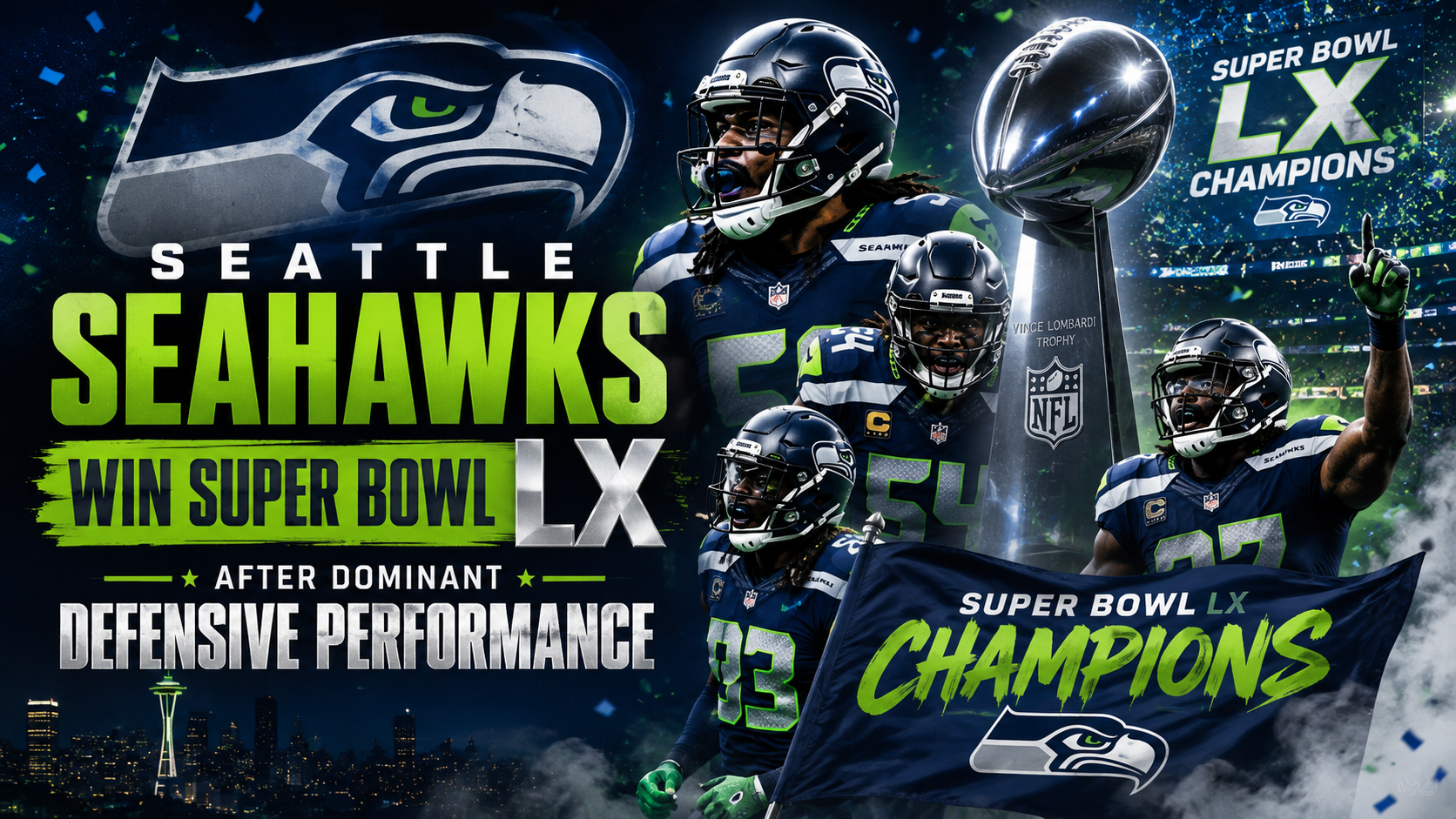
Seattle Seahawks Win Super Bowl LX After Dominant Defensive Performance
The Seattle Seahawks won Super Bowl LX, defeating the New England Patriots 29–13 at Levi’s Stadium in Santa Clara on February 8, 2026. The victory delivered Seattle its second championship and completed a season built around one of the NFL’s strongest defensive units.
Seattle controlled the game before pulling away in the fourth quarter. New England generated more offense late, but turnovers, sacks, and early missed opportunities prevented the Patriots from completing a comeback.
1. Seattle Controlled the Game From the Start
Seattle opened the scoring with a Jason Myers field goal and continued building its advantage through special teams.
Myers converted three field goals in the first half, giving the Seahawks a 9–0 lead at halftime. He later finished with five successful field goals, setting a Super Bowl record.
Although Seattle did not score an offensive touchdown during the opening three quarters, its defense consistently prevented New England from gaining momentum.
2. The Seahawks Defense Defined the Championship
The Seahawks entered the game with the league’s top-ranked defense and delivered their most important performance of the season on the championship stage.
Seattle sacked Patriots quarterback Drake Maye six times and intercepted him twice. Defensive pressure repeatedly disrupted New England’s protection and forced the Patriots into difficult down-and-distance situations.
New England punted on its first eight possessions and did not score until the fourth quarter. The Patriots moved the ball more effectively late in the game, but much of that production came after Seattle had established a commanding lead.
3. Kenneth Walker III Powered the Offense
Kenneth Walker III provided Seattle with the consistent offensive production it needed.
The running back carried the ball 27 times for 135 yards and added 26 receiving yards, finishing with 161 yards from scrimmage. His performance earned him Super Bowl LX Most Valuable Player honors.
Walker became the first running back to receive the Super Bowl MVP award since Terrell Davis following Super Bowl XXXII.
His ability to gain yards and extend drives helped Seattle manage possession, reduce pressure on quarterback Sam Darnold, and keep New England’s defense on the field.
4. Seattle Broke the Game Open in the Fourth Quarter
The Seahawks entered the fourth quarter leading 12–0 before producing the game’s decisive scoring run.
Sam Darnold connected with AJ Barner for a 16-yard touchdown, increasing Seattle’s lead to 19–0. New England responded with a 35-yard touchdown pass from Drake Maye to Mack Hollins, but Seattle quickly restored control.
Later in the quarter, Uchenna Nwosu returned an interception 45 yards for a touchdown, extending the lead to 29–7 and effectively ending New England’s comeback hopes.
5. New England’s Late Response Was Not Enough
Maye finished with 295 passing yards and two touchdowns, but he also threw two interceptions and spent much of the game under heavy pressure.
Mack Hollins caught New England’s first touchdown, while Rhamondre Stevenson added another receiving score in the closing minutes. However, the Patriots’ early offensive struggles left them with too much ground to recover.
The defeat ended an impressive first season under head coach Mike Vrabel, during which New England reached the championship game with a 14–3 regular-season record.
6. Key Super Bowl LX Figures
Final score: Seattle Seahawks 29–13 New England Patriots
- Venue: Levi’s Stadium, Santa Clara
- Super Bowl MVP: Kenneth Walker III
- Walker rushing yards: 135
- Seattle sacks: 6
- New England turnovers: 3
- Jason Myers field goals: 5
- Halftime score: Seattle 9–0 New England
7. What Bettors Can Learn From the Result
Super Bowl LX demonstrated why matchup analysis should extend beyond offensive star power.
Seattle’s defense, pass rush, rushing production, and special teams had a greater influence on the result than total yardage alone. The teams finished with similar total-yard figures, but Seattle protected the football while New England committed three turnovers.
Important factors to consider in future championship matchups include:
- Offensive-line performance against pressure
- Turnover rates
- Rushing efficiency
- Red-zone execution
- Special-teams consistency
- Quarterback performance under pressure
- Defensive ability to create negative plays
A team does not always need the most explosive passing performance to control a championship game. Field position, possession, and mistakes can determine the outcome.
8. Final Takeaway
Seattle’s victory was built on discipline and balance.
Walker supplied the rushing production, Myers converted scoring opportunities, and the defense prevented New England from establishing an early rhythm. When the Patriots finally responded, Seattle produced the game-changing turnover that sealed the championship.
Final takeaway: The Seahawks defeated the Patriots 29–13 because they controlled the line of scrimmage, avoided turnovers, and delivered the stronger defensive performance when the season mattered most.
Disclaimer: This article is provided for general educational and informational purposes only. Betting involves risk, and no outcome is guaranteed. Please play responsibly.